
Coming from the land of two-wheeled trailers, I’ve long held some reservations about the single-wheeled variety. Most two-wheeled models behave in, more or less, the same way. One wheel has always seemed, well, weird.
I guess it’s time for me to slay a couple of myths about BOB Trailers.
Myth number one: The Hitch
Two-wheeled trailers carry their load squarely on, well, their own two wheels, and only a small portion of the load is transferred to the hitch. Conversely, BOB trailers shift a good portion of their load-carrying capability forward, to the hitch. Not only that, but the hitch must also resist the additional torsional force inherent in single-wheeled designs.
Bob pin with a Lanyard

So how does the BOB hitch fare? By all accounts, very well. The BOB’s front fork/quick release connection is remarkably solid, resisting all torsional forces and shouldering its share of the trailer’s load. The connection between trailer and bike relies on two pins to hold the quick release in the trailer fork’s dropouts, and as long as the pins are in place, it means happy riding. Older BOB trailers (pre-2000) used essentially a cotter pin for this job, and, unfortunately, people lost them. Often. Newer models, however, introduced a new pin design that snapped tightly into place against a rivet on the fork dropouts, ensuring that it wouldn’t snap off. Later improvements include a rubber lanyard, to keep you from losing them while the trailer is disconnected from the bike.
The Jackknife Technique

The fork/quick release connection can be somewhat problematic when trying to attach a trailer that is already loaded. I’ve found it’s easier to attach the trailer before filling it up. Parking also requires some effort with this design. If you have enough room, something I call the “jackknife technique” works relatively well, and adding a Greenfield kickstand to the trailer fork or an ESGE double kickstand to your bike will help in all situations. For more information, check out this article about kickstands on BOB trailers.
All things considered, the BOB quick-release hitch is both strong and reliable and its simple design makes it very easy to use. Oh, it’s also important to note that BOB hitches are available for nutted axles, as well.
Myth number two: Handling
 Another myth I held about BOBs, and other single-wheeled trailers were that when loaded, they tended to pull the bike around. I was happy to find this wasn’t as much of an issue as I feared. The trailer wheel tracks faithfully behind the bike, carving perfect arcs around corners and in evasive maneuvers. Trailers with two wheels have a steering lag and tend to stick out on one or both sides of the bike, requiring you to be constantly aware of the trailer, meaning that you have to ride differently. The BOB requires no such awareness, allowing you to ride almost completely normally. Because of this, the BOB shines on single-track and in-city cycling, where handling is critical.
It is important to note, however, that overloading a BOB could be dangerous and will adversely affect the bike’s handling. The rated capacity of both the Yak and Ibex is 70 pounds.
Construction
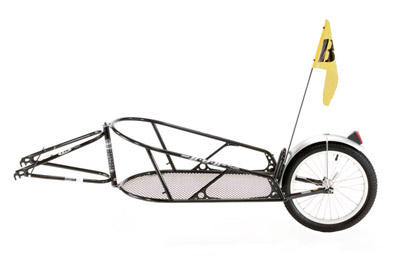
BOBs are well built. Made of tubular 4130 Chromoly steel, their truss design is very strong. The fact that it is made of steel also makes it easier to find someone who can weld it back together in out-of-the-way places, should something bad happen. Its cargo rails do a good job of keeping Dry Saks or other bags in place and allow multiple points of attachment for bungee cords, cargo nets, or other tie-downs, and its expanded metal floor allows unobstructed drainage. The space between the frame members does allow smaller items to slip through, but this is easily remedied with liners and cargo nets, instead of a bag. BOBs are also relatively light, as compared to other bike trailers, weighing in at only 13.5 and 17 pounds for the Yak and Ibex, respectively. The BOB trailer’s iconic design is also stylish enough to ensure that you won’t be confused with a homeless person, which is, sadly enough, a common occurrence when riding with a trailer.
Conclusion
In this review, I haven’t distinguished BOB Yak and BOB Ibex models. I am instead reviewing them for their common design characteristics because compared to most other trailers, they are much more alike than different. Overall, I found BOBs to be very reliable, lightweight touring trailers for less-than-ideal riding conditions. If you just have to ride your bike there, the BOB will dutifully, and capably, follow.